
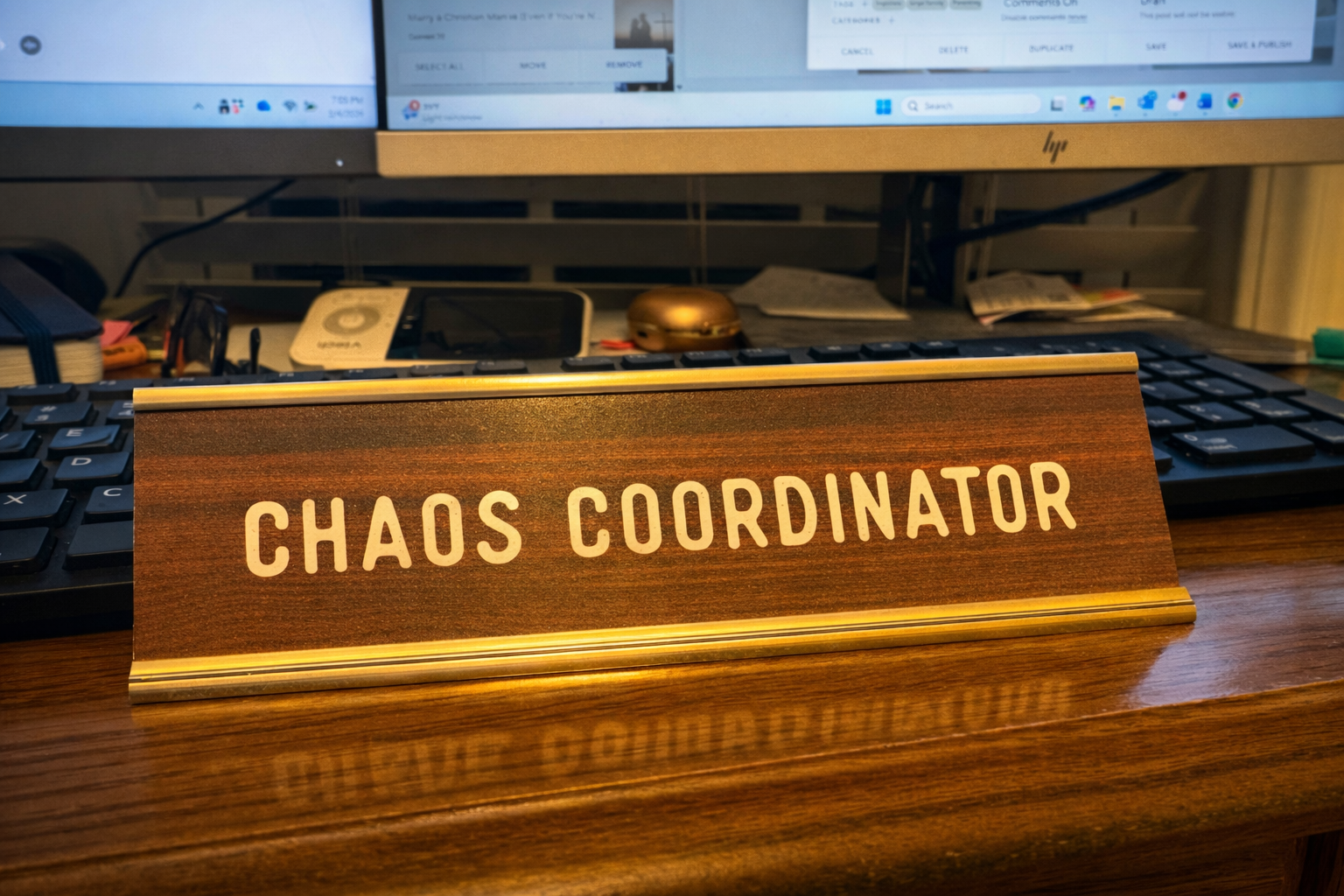
I have a placard on my desk that says, “Chaos Coordinator.” It is a title that I fully embrace. I’m proud of the chaos I coordinate daily. Whether that’s the people and projects I manage for work or the little people that follow me everywhere (even into the bathroom), there is always a little bit of chaos—and that’s the way I like it. People ask me all the time how I juggle six kids, a full-time job, and homeschooling. Sometimes they ask with genuine curiosity. Sometimes with wide eyes and a tone that suggests concern for my wellbeing. Occasionally with a look that says, “I would simply pass away.”
The truth is: I don’t juggle it gracefully. I juggle it intentionally.
And the first reason this works at all is simple: I don’t do it alone.
The Village (a.k.a. Family Support Systems)
We are incredibly blessed with family who show up. Often they show up without knocking—mostly because they live next door. My in-laws and brother in-law all live on the family compound. This is the key to most everything. In fact, my brother-in-law is EVERYONE’s Uncle (even kids not related to us at all). The help comes in various forms. Sometimes that looks like taxi service to activities. Sometimes it’s childcare so I can focus on work or run an event. Sometimes it’s emotional support on days when everything feels louder than usual. Having people who know our kids, love them deeply, and aren’t afraid of the chaos makes all the difference. This kind of support doesn’t remove the chaos—it makes it manageable.
I used to think I needed to “have it together” before accepting help. Now I understand that accepting help is how things stay together at all.
Lowering the Bar (Especially for Cleanliness)
Let’s just get this out of the way: my house is lived in.
If there’s one thing I’ve given up, it’s a straight house. I actually sent my co-workers a photo of my kids’ playroom that had nugget cushions strown, stuffed animals on the floor, play kitchen items ready to hurt the next adult that walked through, and a hammock hung across the entire room. I sent this photo like it was a badge of honor. Also - to prove that this is real life.
There are seasons when the floors are clean and the laundry is folded - though rare. There are also seasons when I’m just proud everyone has socks—matching is optional. I’ve learned to lower my standards of cleanliness without lowering my standards of care.
A messy house does not mean a neglected family. It means energy is being spent on people instead of perfection. If the kitchen is functional and no one is stepping on LEGO barefoot (a true miracle), we’re doing just fine.
Once I stopped chasing perfection at home, I had more energy to focus on what actually keeps us moving.
Systems Over Willpower
I rely heavily on systems, because willpower fades as the day goes on.
We live by color-coded calendars. Each child has a color. Work has a color. Homeschool outings have a color. If it isn’t on the calendar, it probably isn’t happening—or at least not on time. Seeing everything laid out visually helps me spot overwhelm before it happens and make adjustments early - including coordinating overlapping sports and rehearsal schedules. The Outlook calendar matches the dry erase calendar which promptly displays all the important happenings. My number one taxi service (everyone’s favorite uncle) lives by the calendar.
We also batch tasks wherever possible: school planning, laundry, emails, meal prep - scratch that meal prep is my Achilles heel, it’s mostly nuggets, noodles, burgers, or frozen pizza on rotation given some of my sensory adverse kids. Still, doing things in chunks saves my brain from constant decision-making, which is honestly one of the most exhausting parts of parenting.
Homeschooling in a Real House With Real Life Happening
Homeschool doesn’t look like quiet desks and matching workbooks here. It looks like flexibility, overlap, and learning woven into real life. Older kids sleep later and work more independently while I help younger ones. This wasn’t always intentional - but it works for us. Sometimes they have to wait until a work meeting is over to get help (cue the messy playroom). Music practice happens while someone else is reading. Science discussions spill into evening conversations. Dinner together is basically impossible because the homeschool table is the dinner table—and it’s usually covered in that day’s art or science projects.
Some days are incredibly productive. Some days are more about survival and character development. Both count. No week is typical and I don’t hold myself to that standard (most of the time). The goal is to raise kind, Christ-followers, that will find something they LOVE to do and everything else is a bonus.
Full-Time Work + Full-Time Motherhood
Work adds another layer to the juggle. Working full-time means I’ve had to get very honest about my limits. I plan my days carefully, then promptly throw those plans out the window when a kid wakes up sick, is struggling with math, or crying over social studies, or just because. Basically I let go of the idea that I can give 100% to everything all the time. I can give 100% overall—but it’s spread across a lot of people and responsibilities.
And yes, some days that means frozen pizza, unfinished to-do lists, and going to bed knowing tomorrow is another chance.
I work odd hours, which means my co-workers think I work non-stop until 10 p.m. at night, but I actually just spread my work out at odd times throughout the day (and sometimes on weekends). I don’t believe in work-life balance, that would mean things are equal. I instead subscribe to work-life integration. I don’t mind taking a phone call at night or on a weekend if that means I get to take my kids to the park or on a field trip that day.
And through all of it—plans, calendars, messes, and missed expectations—there’s one thing holding it together.
Grace Is the Glue
At the end of the day, what holds all of this together isn’t a planner or a system—it’s grace. Grace for myself. Grace for my kids. Grace for the season we’re in. New babies come with a certain amount of chaos and a kid having a hard time making friends requires some attention. Other times, work travel derails school and we band together to do the best we can.
We’re building something here: a family that knows how to work together, adapt, laugh at the chaos, and love deeply. It’s imperfect. It’s loud. It’s exhausting. And it’s incredibly good.
So when people ask, “How do you do it?”
The answer is still: imperfectly.
But also—with help, intention, flexibility, and a whole lot of grace.